


A Utah residential lease agreement is a legally binding contract between a landlord and a tenant that outlines the rental terms, each party’s responsibilities, and the rules governing the tenancy in 2026. A strong contract helps set clear expectations and keeps landlords and tenants on the same page throughout the rental term.
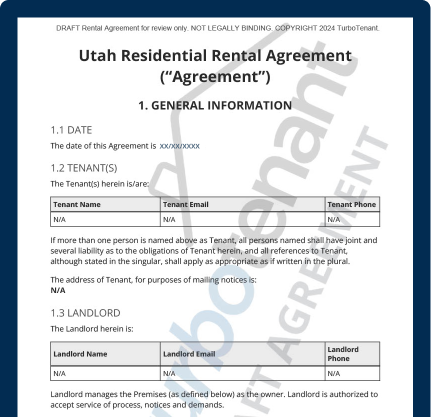
In the past, landlords have used paper templates and forms to create lease agreements. However, TurboTenant’s downloadable PDF lease agreement builder modernizes the process by providing customizable contracts that comply with Utah and federal leasing laws in an easy-to-fill-out format.

Utah Residential Lease Agreement
Current PageCreate a compliant Utah lease agreement in 15 minutes with TurboTenant's rental contract builder.
Utah Month-to-Month Lease Agreement
Learn MoreBuild your Utah month-to-month lease agreement in 15 minutes.
Required Landlord Disclosures (4)
Landlords must provide tenants with specific information about the rental unit and the Utah residential lease agreement at the time of signing. Both state and federal laws regulate these disclosures:
- Lead-based paint: For units built before 1978, landlords must disclose any known lead-based paint and hazards, share any available records, include a Lead Warning Statement in the lease, and provide tenants with the EPA-approved lead hazard pamphlet. This is the only federally mandated disclosure on this list (42 U.S.C. § 4852d).
- Methamphetamine: A landlord with actual knowledge that the property is contaminated from the use, storage, or manufacture of methamphetamine must disclose that contamination in the lease agreement. The landlord may (but is not required by law to) report the contamination to the government agency that monitors decontamination (Utah Code Ann. § 57-27-201).
- Move-in checklist: Before the tenant moves in, the landlord must do one of the following: provide a written inventory of the unit’s condition (excluding ordinary wear and tear), furnish the tenant a form to document the condition, or offer a walkthrough inspection (Utah Code Ann. § 57-22-4).
- Landlord’s name and address: At or before the start of the term, landlords must provide their name, address, and telephone number, or the name and telephone number of the person authorized to manage the property or act on the owner’s behalf (Utah Code Ann. § 57-22-4).
Security Deposit Regulations
Maximum security deposit amount: Utah law does not limit the amount landlords may charge for a security deposit.
Receipt of deposit: Utah landlords are not required to provide tenants with a written receipt for the security deposit.
Deduction tracking: Landlords may apply security deposit funds to unpaid rent, damages beyond reasonable wear and tear, other costs or fees provided for in the lease, or cleaning of the unit. If the landlord makes any deductions, they must give the tenant a written notice that itemizes and explains each deduction (Utah Code Ann. § 57-17-3).
Returning a tenant’s security deposit: Utah landlords must deliver the remaining deposit, any prepaid rent, and any itemized deduction notice within 30 days after the tenant vacates and returns possession, sent to the tenant’s last known address or electronically. If the landlord misses that deadline after the tenant properly demands the deposit, the tenant may recover the full deposit and prepaid rent plus a $100 penalty (Utah Code Ann. § 57-17-3 & 57-17-5).
Landlord’s Access to Property
Advance notice: Landlords must provide tenants with at least 24 hours’ notice before entering the property unless the Utah residential lease agreement states otherwise (Utah Code Ann. § 57-22-4).
Immediate access: Utah law does not specifically address emergency entry. Even so, landlords generally may enter a rental unit without advance notice during emergencies that threaten people or property, and landlords should spell out emergency entry in the lease.
Landlord harassment: Landlords who repeatedly enter a property without proper notice or valid cause could face claims of landlord harassment. In some situations, tenants may have legal grounds to terminate the lease early without penalty.
Rent Payment Laws
Grace period: Utah law does not require landlords to provide a mandatory grace period for late rent payments. However, landlords may choose to include one in their standard Utah lease agreements.
Late rent fees: Utah law caps late fees at the greater of $75 or 10% of the monthly rent. Landlords may charge the fee only once per late payment, and it cannot accrue daily. Landlords must also clearly outline late fee terms in the lease agreement (Utah Code Ann. § 57-22-4).
Tenant’s right to withhold rent: After a tenant gives written notice of a deficient condition, the landlord has a corrective period to act, generally three calendar days for a habitability standard or 10 calendar days for a lease requirement. For a dangerous condition that poses an imminent risk to life or safety, the landlord must take substantial action within 24 hours. If the landlord does not act, the tenant may repair the condition and deduct the cost from future rent, up to 2 months’ rent, as long as the tenant stays compliant with the lease and provides receipts within five calendar days after the next rental period begins (Utah Code Ann. § 57-22-6).
Breach of Rental Agreement
Missed rent payment: After a missed rent payment, Utah landlords may serve a 3-business-day Notice to Pay or Quit (Utah Code Ann. § 78B-6-802).
Lease violation: For a curable lease violation, Utah landlords may serve a 3-calendar-day Notice to Comply or Quit, which allows the tenant to fix the issue within 3 days. For serious or incurable violations, such as criminal activity, an unlawful business, or a nuisance, landlords may serve a three-calendar-day unconditional Notice to Quit that does not allow the tenant to cure (Utah Code Ann. § 78B-6-802).
Self-help evictions: Utah landlords should never attempt a self-help eviction by personally removing tenants, changing locks, or shutting off utilities. Self-help evictions are illegal, and landlords must follow Utah’s formal eviction process to remove a tenant.
Lease abandonment: Tenants who break a lease early without a qualifying legal reason may remain responsible for unpaid rent and related fees for the remainder of the lease term. However, Utah landlords must make a reasonable effort to re-rent the unit and mitigate damages. If a replacement tenant moves in, the former tenant is generally responsible only for the period the unit remained vacant, plus a reasonable re-renting commission and restoration costs (Utah Code Ann. § 78B-6-816).
Ending a Lease
Month-to-month: Landlords or tenants who wish to end a month-to-month lease in Utah must give at least 15 calendar days’ written notice before the end of the rental period (Utah Code Ann. § 78B-6-802).
Fixed-term: Utah tenants may break a lease early and without penalty in certain situations. Active-duty servicemembers who receive qualifying military orders may terminate under the federal Servicemembers Civil Relief Act (50 U.S.C. § 3955). A tenant may also terminate when a serious habitability issue substantially affects health or safety, and the landlord fails to correct it within the required time (Utah Code Ann. § 57-22-6).
Property abandonment: If a tenant leaves personal belongings after moving out, the landlord must provide written notice and may treat the property as abandoned if the tenant does not claim it. The tenant has 15 calendar days after the notice to claim the property by paying any inventory, moving, and storage costs. After that, the landlord may dispose of the property and attempt to recover disposal costs from the tenant (Utah Code Ann. § 78B-6-816).
Renewing a Lease
Required renewals: Utah landlords are generally not required to renew a Utah residential lease agreement once the lease term expires.
Required notice: Utah landlords must provide at least 15 calendar days’ written notice before ending a month-to-month lease. A standard fixed-term lease expires on its ending date without notice, so landlords generally do not need to give advance notice when they choose not to renew (Utah Code Ann. § 78B-6-802).
Utah Residential Lease Agreement FAQs
Does a landlord have to provide a copy of the lease in Utah?
As of 2026, Utah landlords must give tenants a written copy of the lease agreement, along with any rules or regulations that apply to the rental property (Utah Code Ann. § 57-22-4(7)(b)).
What is the grace period for rent in Utah?
Utah law does not require landlords to offer a grace period for late rent payments. However, landlords may choose to include a grace period in the lease agreement.
Can a landlord refuse to renew a lease in Utah?
Yes, Utah landlords may choose not to renew a lease once the rental term ends, unless the lease agreement states otherwise.
Does a Utah lease need to be notarized?
No, Utah residential leases do not require notarization. A lease agreement becomes enforceable once both the landlord and tenant sign the document.
Can you withhold rent for repairs in Utah?
Utah tenants may arrange for certain necessary repairs if the landlord fails to respond within 24 hours after receiving notice. Tenants can deduct repair costs from rent, up to 2 months’ rent, and must provide an itemized receipt for the completed work (Utah Code Ann. § 57-22-6(4)(a-b)).
Disclaimer: TurboTenant does not provide legal advice. This material has been prepared for informational purposes only. All users are advised to review applicable local, state, and federal laws and consult legal counsel should questions arise.