


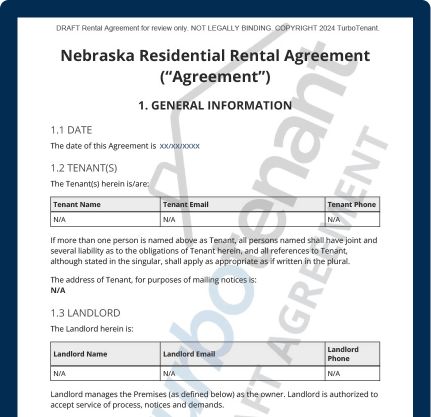
A Nebraska residential lease agreement outlines the rights and responsibilities of both the landlord and tenant. These legally binding contracts typically include essential details like the rent amount, payment schedule, lease duration, maintenance responsibilities, and other important rules for using the rental property.
To ensure compliance, Nebraska landlords can use TurboTenant to create custom PDF lease agreements. First, though, let’s examine some of Nebraska’s required disclosures and discuss the regulations and rules that dictate how landlords must interact with their tenants.

Nebraska Residential Lease Agreement
Current PageCreate a compliant Nebraska lease agreement in 15 minutes with TurboTenant's rental contract builder.
Nebraska Month-to-Month Lease Agreement
Learn MoreBuild your Nebraska month-to-month lease agreement in 15 minutes or less.
Room Rental Agreement Nebraska
Learn MoreRent your spare room with a Nebraska room rental agreement today.
Required Landlord Disclosures (2)
Under state and federal law, landlords must provide tenants with certain information about the property before or at the start of a new lease. Here’s what landlords in Nebraska have to know:
- Lead-based paint and hazards: Nebraska landlords must follow federal guidelines for lead-based paint disclosures, which apply to most rental homes built before 1978. Landlords must disclose known lead-based paint and hazards, include a lead warning statement in the lease, and provide an EPA-approved pamphlet (42 U.S.C. § 4852d).
- Landlord/agent identity: State law requires landlords or their agents to disclose, in writing, the name and address of the person authorized to manage the property, as well as the owner or an authorized agent who can receive notices and service of process (Neb. Rev. Stat. § 76-1417).
Security Deposit Regulations
Maximum security deposit amount: Nebraska landlords may charge up to 1 month’s rent as a security deposit. If applicable, landlords can also charge a pet deposit of up to 25% of 1 month’s rent (Neb. Rev. Stat. § 76-1416).
Receipt of deposit: Nebraska state law does not require landlords to give tenants receipts for their security deposits.
Deduction tracking: Nebraska landlords must provide tenants with an itemized list of security deposit deductions within 14 days after the termination of the tenancy, delivery of possession, and the tenant’s demand. Landlords may only use security deposit funds to cover unpaid rent, damages, and other charges provided in the lease (Neb. Rev. Stat. § 76-1416).
Returning a tenant’s security deposit: Nebraska requires landlords to return a tenant’s security deposit, minus any lawful deductions, within 14 days after the termination of the tenancy and delivery of possession and demand by the tenant (Neb. Rev. Stat. § 76-1416).
Landlord’s Access to Property
Advance notice: In most cases, Nebraska landlords must provide tenants with at least 24 hours’ written notice before entering the rental property. They may enter only at reasonable times, and the written notice must include the reason for entry and a reasonable timeframe for access (Neb. Rev. Stat. § 76-1423).
Immediate access: Nebraska landlords may enter a property in an emergency or when it is impracticable to provide written notice to their tenant (Neb. Rev. Stat. § 76-1423).
Landlord harassment: Nebraska state law protects tenants from unlawful entry or repeated demands for legal entry that, in essence, harass the tenant. Tenants facing harassment can obtain a court order to stop the harassment or terminate their lease. In both cases, they may sue their landlord for damages equal to no less than 1 month’s rent and reasonable attorney’s fees (Neb. Rev. Stat. § 76-1438).
Rent Payment Laws
Grace period: Nebraska state law does not require landlords to offer tenants a grace period to pay rent. Rent is payable at the time and place agreed upon by the parties, unless the lease says otherwise (Neb. Rev. Stat. § 76-1414).
Late rent fees: Nebraska does not have a statutory cap for late rent fees. Landlords may set late fees at their discretion as long as the Nebraska residential lease agreement documents them. Landlords can pursue civil remedies under Nebraska’s bad-check statute (Neb. Rev. Stat. §§ 28-611).
Returned check fees: Nebraska does not set a specific statutory cap on a returned check (NSF) fee; however, a landlord may charge a reasonable fee if it’s stated in the lease (Neb. Rev. Stat. § 28-611).
Tenant’s right to withhold rent: If a landlord deliberately or negligently fails to supply running water, hot water, heat, or other essential services, Nebraska tenants may give written notice, obtain reasonable amounts of those services, and deduct the actual and reasonable costs from rent (Neb. Rev. Stat. § 76-1427).
Breach of Rental Agreement
Missed rent payment: If a tenant misses their rent payment, Nebraska landlords can issue a 7-Day Notice to Pay or Quit. If the tenant does not pay within 7 calendar days after written notice, the landlord may terminate the rental agreement (Neb. Rev. Stat. § 76-1431).
Lease violation: Landlords can issue a 14- or 30-Day Notice to Quit or Cure if a tenant materially breaches the terms of a standard rental lease agreement in Nebraska. This notice gives the tenant 14 days to fix the violation. Otherwise, the lease will terminate at the end of the 30-day notice period (Neb. Rev. Stat. § 76-1431).
Self-help evictions: Landlords should not attempt to remove tenants by shutting off utilities, changing locks, or removing the tenant’s belongings. If a landlord illegally evicts a tenant, the tenant may recover possession or terminate the lease. After that, they can recover an amount equal to 3 months’ rent as liquidated damages, plus a reasonable attorney’s fee. If the lease is t terminated, the landlord must return any prepaid rent and the security deposit (Neb. Rev. Stat. § 76-1430).
Lease abandonment: If the lease requires notice, Nebraska tenants must notify their landlords if they will be absent from the rental property for more than 7 days. A tenant absent without notice for 1 full rental period or 30 days, whichever is less, may be considered to have abandoned the property. In these situations, landlords can take possession and make reasonable efforts to re-rent the unit (Neb. Rev. Stat. § 76-1432).
Ending a Lease
Month-to-month: In Nebraska, landlords and tenants can end a month-to-month lease by providing the other party with at least 30 days’ notice (76-1437.2).
Fixed-term: Nebraska tenants can end a fixed-term lease early for several reasons, including domestic violence (76-1431.01), landlord harassment (76-1438), landlord’s failure to maintain and repair the property (76-1419), or any other violations of the lease by the landlord (76-1425).
Property abandonment: Within 6 months of lease termination or property abandonment, Nebraska landlords must provide their tenants with notice of the date by which they must claim their personal property and where it can be picked up, with a 7-14 day notice window depending on the delivery method (69-2303). Landlords can choose where to store the abandoned property (69-2306). After the notice window, property worth less than $2,000 in total can be kept or disposed of by the landlord, while property worth over $2,000 in total must be sold through public sale, with the proceeds belonging to the State Treasurer, minus landlord costs (Neb. Rev. Stat § 69-2308).
Renewing a Lease
Required renewals: Landlords are not legally required to let tenants renew Nebraska residential lease agreements once the lease term expires. They must, however, provide proper notice when ending a periodic tenancy, such as a week-to-week or month-to-month lease.
Required notice: Nebraska state law requires landlords to give 7 days’ notice when terminating a week-to-week standard lease and 30 days’ notice before the periodic rental date when terminating a month-to-month lease (Neb. Rev. Stat. § 76-1437).
Nebraska Residential Lease Agreement FAQs
Does a landlord have to provide a copy of the lease in Nebraska?
No. Nebraska law does not require landlords to provide tenants with a copy of a standard residential lease agreement.
What is the grace period for rent in Nebraska?
Nebraska does not require a statewide grace period for late rent payments. Unless the lease provides one, landlords may enforce late rent rules according to the terms within the rental agreement (Neb. Rev. Stat. § 76-1414)
Can a landlord refuse to renew a lease in Nebraska?
Yes. Nebraska landlords can refuse to renew a fixed-term lease once the term expires, as long as they do not violate fair housing laws or other legal protections. For periodic tenancies, either party may terminate a week-to-week tenancy with 7 days’ written notice or a month-to-month tenancy with 30 days’ written notice (Neb. Rev. Stat. § 76-1437).
Does a Nebraska lease need to be notarized?
No. Nebraska residential leases do not need to be notarized to be considered legally enforceable. Once both parties sign the lease, the agreement can establish the rental terms between the landlord and tenant.
Can you withhold rent for repairs in Nebraska?
Nebraska tenants typically cannot withhold rent for ordinary repairs. But if a landlord deliberately or negligently fails to provide running water, hot water, heat, or another essential service, the tenant may give written notice and pursue certain legal remedies, which include paying for the service and deducting the actual, reasonable cost from rent (Neb. Rev. Stat. § 76-1427).
Disclaimer: TurboTenant does not provide legal advice. This material has been prepared for informational purposes only. All users are advised to check all applicable local, state, and federal laws and consult legal counsel should questions arise.