


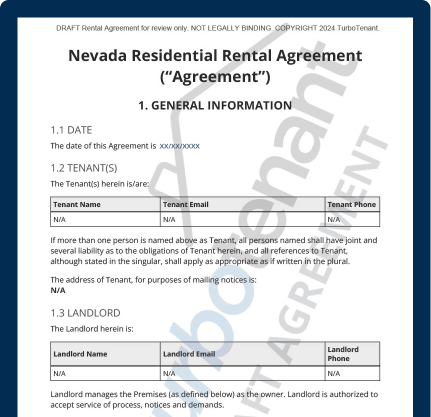
A Nevada residential lease agreement covers all aspects of property rental and serves as a guide in disputes by clarifying the landlord’s and tenant’s rights and responsibilities.
Although landlords can use TurboTenant’s lawyer-approved lease agreement generator, both landlords and tenants should understand the laws governing rental contracts before signing a lease. In this guide, we’ll go over everything you need to know about lease agreements, including security deposit regulations, rent collection laws, and more.

Nevada Residential Lease Agreement
Current PageCreate a compliant Nevada residential lease agreement in 15 minutes with TurboTenant's rental contract builder.
Nevada Month-to-Month Lease Agreement
Learn MoreBuild your Nevada month-to-month lease agreement in 15 minutes.
Room Rental Agreement Nevada
Learn MoreConsidering renting out an extra room? Make it official with a Nevada room rental agreement.
Required Landlord Disclosures (11)
In addition to the standard wording found in most residential lease agreements and the added language required by Nevada state law, landlords must also disclose certain information about their properties in 2026.
In Nevada, landlords must disclose the following:
- Lead paint: For any units built before 1978, landlords must disclose any known information on lead-based paint or lead-based paint hazards in the unit. This requirement is the only federally mandated rental property disclosure (42 U.S.C. § 4852d).
- Signed lease copy: Nevada landlords must provide one free copy of the written rental agreement to the tenant when the landlord and tenant execute the agreement. Landlords must also provide additional copies within a reasonable time after the tenant requests them, though they may charge a reasonable fee for extra copies (Nev. Rev. Stat. § 118A.200(2)).
- Foreclosures: Nevada law requires landlords to inform tenants if the property they are renting is subject to foreclosure proceedings (Nev. Rev. Stat. § 118A.275).
- Public nuisance: All Nevada residential lease agreements must include language that describes the penalties for creating or allowing a public nuisance on the property. Landlords can hold tenants responsible for nuisances on the property, even if the tenant is not the cause (Nev. Rev. Stat. § 118A.200(3)(l)).
- American flag: Nevada landlords are legally required to inform tenants that they can display an American flag for personal use on a pole, staff, or in a window (Nev. Rev. Stat. § 118A.200(3)(n)).
- Late fees: If a landlord charges a late fee, the lease agreement must state it (Nev. Rev. Stat. § 118A.200(3)(g)). The fee cannot exceed 5% of the periodic rent, and landlords cannot increase it based on a previously imposed late fee. (Nev. Rev. Stat. § 118A.210).
- Landlord contact info: Rental lease agreements in Nevada must disclose the name and address of the landlord or person responsible for managing the property (Nev. Rev. Stat. § 118A.260).
- Move-in checklist: Nevada written rental agreements must include a signed record of the inventory and condition of the premises under the tenant’s exclusive custody and control (Nev. Rev. Stat. § 118A.200(3)(k)).
- Rent and fee disclosure: Nevada written rental agreements must state the rent amount, payment method and timing, required fees and their purposes, required deposits and refund conditions, utility payment responsibilities, and any charges for late rent, partial rent, or returned checks (Nev. Rev. Stat. § 118A.200(3)).
- Code violation reporting procedure: Nevada written rental agreements must explain the procedure tenants can use to report a nuisance or building, safety, or health code violation to the appropriate authorities. Add this to the required disclosure list because Nevada requires it in written rental agreements (Nev. Rev. Stat. § 118A.200(3)(m)).
- Single-family rental disclosure: Certain single-family residential rental agreements must include a statutory disclosure at the top of the first page in a font size at least twice as large as any other font in the agreement. The disclosure explains the rules for notarization, property manager signature, and landlord contact information. It confirms that the rental agreement remains valid and enforceable even if those items do not apply (Nev. Rev. Stat. § 118A.200(4)).
Security Deposit Regulations
Maximum security deposit amount: Nevada landlords cannot require a security deposit, surety bond, last month’s rent, or any combination of those amounts that exceeds 3 months’ periodic rent (Nev. Rev. Stat. § 118A.242(1-2)).
Receipt of deposit: Landlords in Nevada must provide tenants with a signed receipt for their security deposit upon request (Nev. Rev. Stat. § 118A.250).
Deduction tracking: Landlords may withhold funds from the security deposit for unpaid rent or damages caused by the tenant that exceed normal wear and tear. When the landlord returns the remaining funds, they must also provide an itemized receipt documenting the deductions (Nev. Rev. Stat. § 118A.242(4)).
Returning a tenant’s security deposit: The landlord must return the remaining security deposit to the tenant within 30 days of move-out (Nev. Rev. Stat. § 118A.242(4)).
Landlord’s Access to Property
Advance notice: The landlord must give the tenant at least 24 hours’ notice before entering the rental property, and must enter during regular business hours unless the tenant expressly consents to another arrangement (Nev. Rev. Stat. § 118A.330(3)).
Immediate access: Nevada landlords may enter a property without the tenant’s consent or presence in the event of an emergency (Nev. Rev. Stat. § 118A.330(2-3)).
Landlord harassment: Nevada landlords who repeatedly enter a tenant’s unit without consent or proper notice may be committing landlord harassment. Tenants may be able to obtain a court order to keep the landlord out of the property, recover damages through a lawsuit, or potentially cancel the rental agreement (Nev. Rev. Stat. § 118A.500).
Rent Payment Laws
Grace period: Nevada law requires a 3-day minimum grace period for all rent payment due dates (Nev. Rev. Stat. § 118A.210(4a)).
Late rent fees: Nevada written rental agreements must state the rent amount, payment method and timing, grace period duration, and late fee amount. For tenancies longer than week-to-week, landlords cannot charge late fees until the required grace period expires, and late fees cannot exceed 5% of the periodic rent (Nev. Rev. Stat. § 118A.210(4b)).
Tenant’s right to withhold rent: If the landlord fails to maintain the rental unit in a habitable condition after receiving written notice, the tenant may pursue remedies that include withholding rent. The timeline depends on the issue. Some essential-service issues require faster action, while other habitability issues generally give the landlord 14 days to make a reasonable effort to fix the problem (Nev. Rev. Stat. § 118A.355).
Breach of Rental Agreement
Missed rent payment: If a tenant fails to pay rent after it becomes due, Nevada landlords must serve the required 7-Day Notice to Pay or Quit before pursuing eviction for nonpayment. For tenancies longer than week-to-week, landlords must also comply with Nevada’s 3-day grace period before charging late fees (Nev. Rev. Stat. § 40.253(b).
Lease violation: Nevada landlords must provide tenants with a 5-day Notice to Cure or Quit for any violation of the rental lease agreement, except late rent payments or illegal activity (Nev. Rev. Stat. § 40.2516).
Self-help evictions: Nevada prohibits self-help evictions, such as shutting off utilities or changing the locks. Landlords who want to evict a tenant must follow the legal eviction process.
Lease abandonment: If a Nevada landlord believes that a tenant has abandoned a property, they must deliver written notice to the tenant. If the tenant does not respond within 5 days, the landlord can terminate the lease agreement. The landlord may hold the tenant responsible for missed payments or pursue other civil remedies (Nev. Rev. Stat. § 118A.450).
Unenforceable lease clauses: Nevada lease agreements cannot require tenants to waive rights or remedies under Nevada landlord-tenant law, confess judgment, pay the landlord’s attorney fees except as authorized by law, or give the landlord longer notice than the landlord must give the tenant. Landlords should remove any lease clause that attempts to waive or reduce tenant rights under Chapter 118A (Nev. Rev. Stat. § 118A.220).
Ending a Lease
Month-to-month: Landlords or tenants can terminate month-to-month leases with 30 days’ written notice (Nev. Rev. Stat. § 40.251).
Fixed-term: Tenants in Nevada can legally break a lease without penalty in a few different cases, including landlord retaliation or harassment, uninhabitable living conditions, domestic or sexual violence, or entering into active military duty.
Property abandonment: If a tenant abandons personal property when leaving the dwelling unit, the landlord must provide safe storage of the items for at least 30 days. They can dispose of the property after that timeframe without penalty (Nev. Rev. Stat. § 118A.460).
Renewing a Lease
Required renewals: Nevada landlords do not have to renew a residential lease agreement.
Required notice: Nevada landlords and tenants must provide at least 30 days’ written notice to terminate a month-to-month tenancy. Fixed-term leases generally expire at the end of the lease term unless the rental agreement outlines renewal procedures or requires specific notice (Nev. Rev. Stat. § 40.251).
Nevada Residential Lease Agreement FAQs
Does a landlord have to provide a copy of the lease in Nevada?
Yes, landlords in Nevada must provide tenants with a written copy of the lease at the beginning of the lease period (Nev. Rev. Stat. § 118A.200(2)). Providing a signed copy helps ensure both parties understand their rights and responsibilities under the rental agreement.
What is the grace period for rent in Nevada?
Nevada law requires landlords to give tenants a minimum 3-day grace period before charging late fees or initiating eviction proceedings for unpaid rent, as of 2026.
Can a landlord refuse to renew a lease in Nevada?
Yes. Nevada landlords are not required to renew a residential lease once the lease term ends, unless the refusal would violate fair housing laws or local tenant protections.
Does a Nevada lease need to be notarized?
Nevada residential leases typically do not need to be notarized to be valid and enforceable. However, certain single-family rental agreements must include a statutory disclosure about notarization, property manager signatures, and landlord contact information (Nev. Rev. Stat. § 118A.200(4).
Can you withhold rent for repairs in Nevada?
Yes. Nevada tenants may withhold rent or use the repair-and-deduct remedy if a landlord fails to make necessary repairs within 14 days after receiving proper written notice, depending on the severity of the issue and compliance with state law.
Disclaimer: TurboTenant does not provide legal advice. This material has been prepared for informational purposes only. All users are advised to check all applicable local, state, and federal laws and consult legal counsel should questions arise.