







While trying to fill a vacant rental, you might stumble across an applicant who seems perfect. They say they have good income, claim they haven’t been evicted, and appear trustworthy. However, if you don’t vet their information with a tenant background check for landlords, you could end up with a tenant who creates months of stress and costs you thousands of dollars.
A background check lets you verify a tenant’s full financial and rental history rather than unquestioningly trusting everything they tell you. Tenants can easily embellish self-reported information on an application, but a background check cuts through the noise and shows you exactly who wants to live in your property.
In this article, you’ll learn what these reports contain, how to read the results, and how to run a check in minutes. By the end, you’ll know how to screen applicants and catch red flags before signing a lease with the wrong tenant.
Streamline Your Rental Property Management
Marketing. Applications. Leases. Payments.
What is a tenant background check?
A tenant background check is the first foundational step toward securing a reliable renter. Running one gives you a report that pulls a renter’s criminal history, credit report, and eviction records, so you can confirm who will be living in your property and paying you rent.
As a landlord, you can’t simply run background checks whenever you want, though. You must obtain an applicant’s written permission before running a report and follow all applicable landlord-tenant laws throughout the process.
Pro tip: Professional tenant screening tools automatically obtain the applicant’s permission before running reports, so you don’t have to chase signatures or juggle extra paperwork.
What does a background check include?
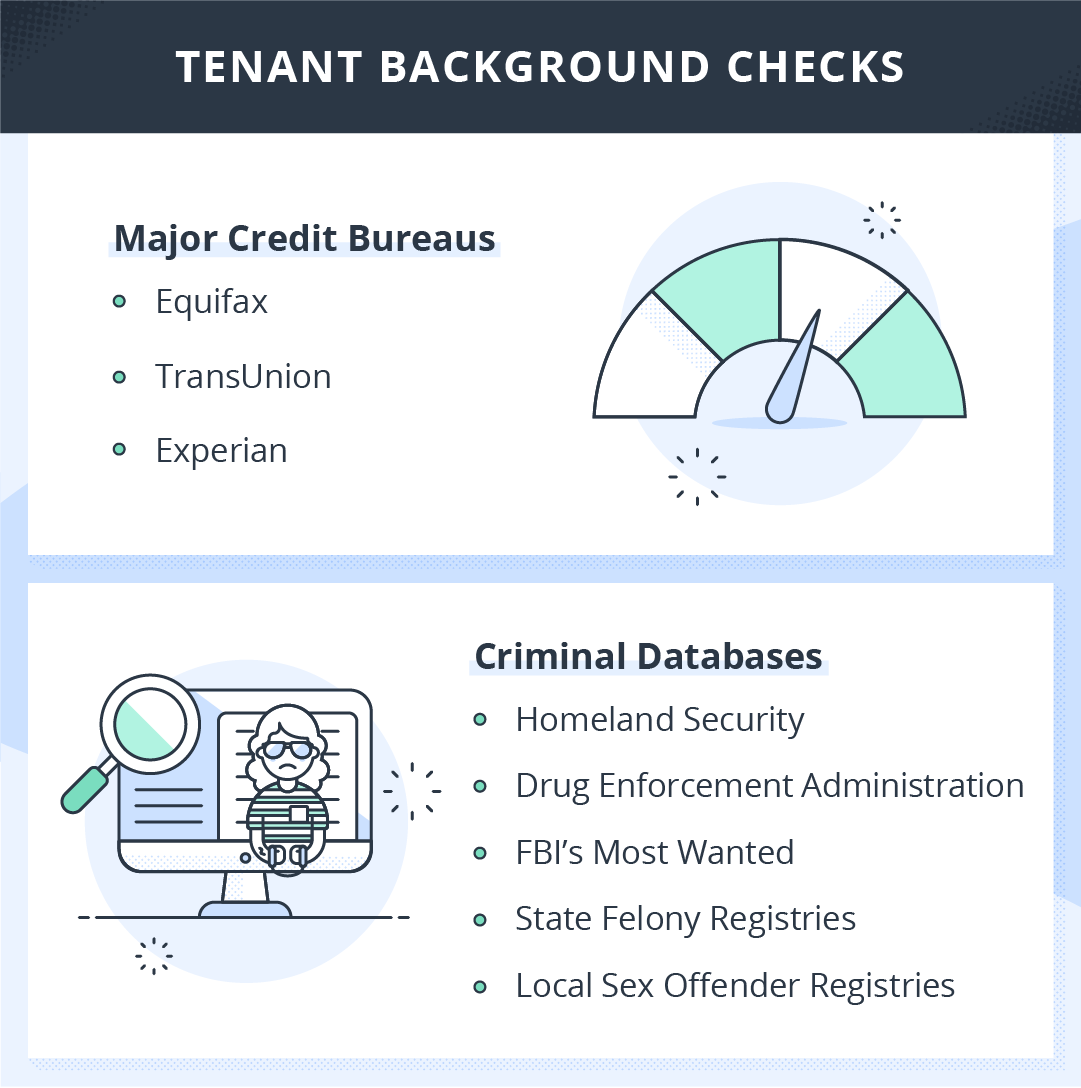
Typically, a rental application background check covers three main areas: criminal history, credit history, and eviction records. Together, these reports give landlords a much clearer, audit-ready picture of a tenant than a rental application alone.
Criminal History
A criminal background check for renters pulls thorough records from federal and state databases to show the applicant’s past legal offenses, if any. For instance, let’s say two applicants both show a misdemeanor from 8 years ago: one involved property damage at a prior rental, and the other was a college-era public intoxication charge. Only one of those speaks to how the tenant may treat your unit. Context matters.
State laws also vary. For example, Texas has no state-level limit on how far back landlords can look or which convictions they can weigh. California, on the other hand, prohibits landlords from citing arrests that never led to a conviction, sealed or expunged records, or blanket “no felons” policies (Cal. Code Regs. tit. 2, §§ 12264-12271).
Credit Report
A credit check for renters itemizes an applicant’s credit score, loan repayment history, outstanding debt, and collections accounts or bankruptcies. Payment history alone accounts for 35% of a FICO Score, the single biggest factor. Weigh payment history over the raw score, as it will signal whether the applicant reliably pays their rent (and other bills) on time.
Eviction History
One of the biggest red flags for a new tenant? Prior court filings or eviction judgments against them. Eviction records will show you whether a renter has a delinquency cycle, which can signal future trouble should you choose to rent to them. Some renters with past judgments are also judgment-proof, meaning there’s little left to collect even if you win a case against them.
As with criminal history, some states limit how landlords can obtain and use eviction records in housing decisions. Always read up on your state’s landlord-tenant laws to make sure you’re within your legal rights before denying a tenant based on their eviction history.
Why run a background check on a tenant?
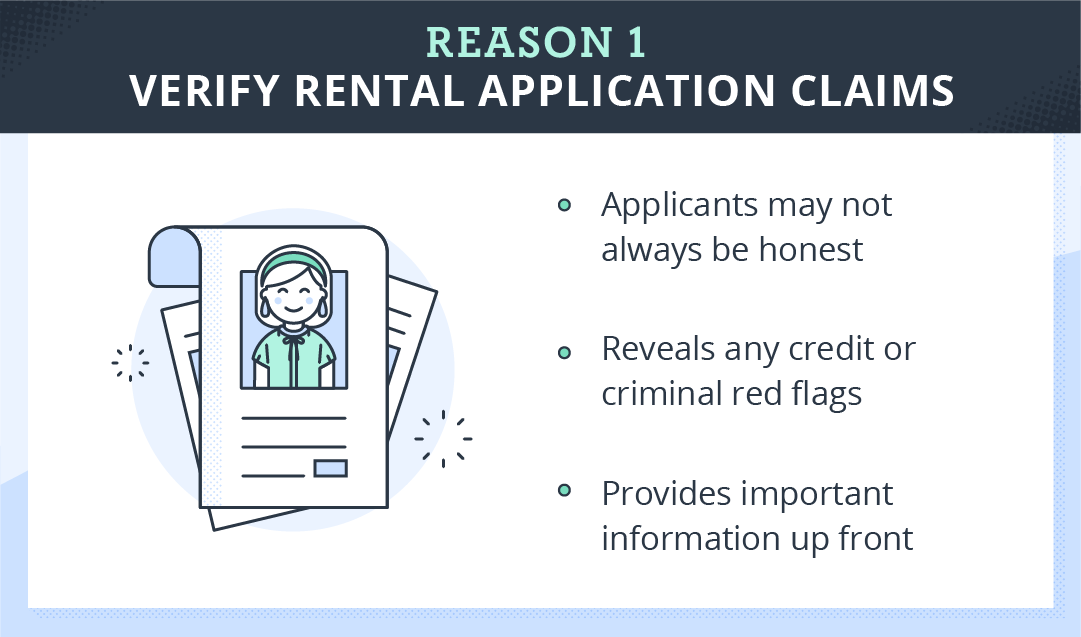
Beyond confirming the information a tenant included in their rental application, a background check will reveal details renters might not otherwise report (often the ones that matter the most in a housing decision). Here’s how wise landlords run checks before signing a new lease:
Catch Red Flags Before You Sign
Tenant background checks for landlords surface common red flags like prior evictions, collection accounts, criminal convictions, or information that contradicts what the applicant reported. Spotting these issues early helps you flag difficult, delinquent, or litigious renters and avoid the property damage, criminal activity, or unpaid rent that come along with them.
Protect Yourself Legally
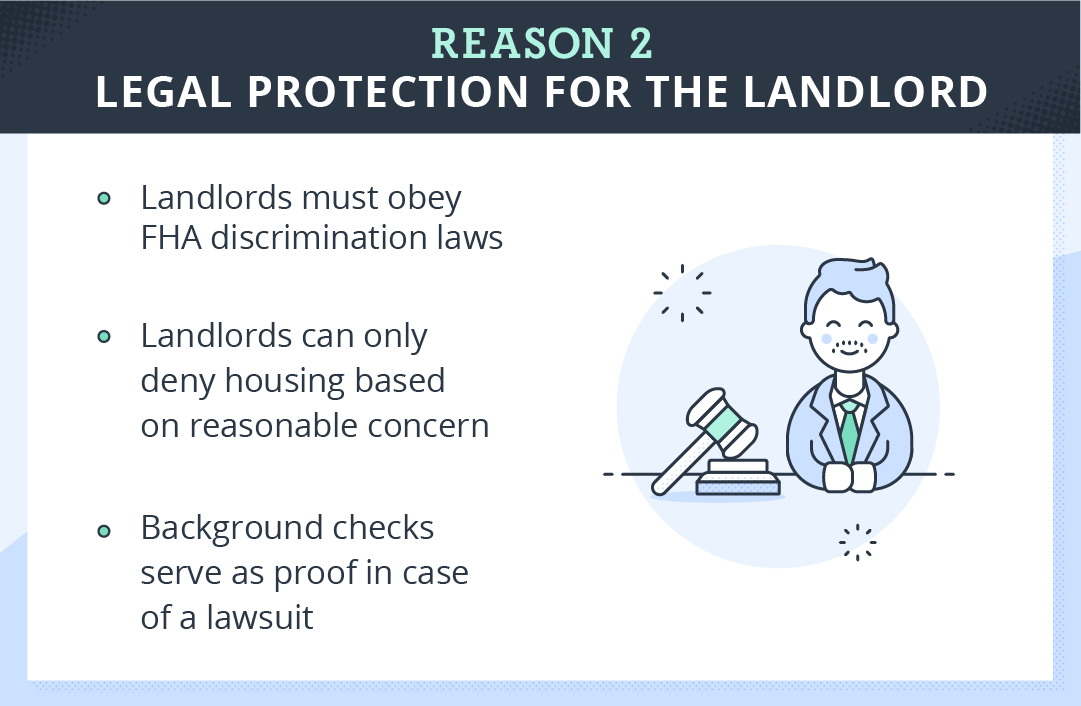
A consistent, document-first tenant screening process creates a recorded set of standards that holds every applicant accountable to the same criteria while staying within the bounds of Fair Housing laws. To justify an application denial, you can point to your screening process and reports on file rather than relying on your memory.
Keep records: Retain reports and denial notices for at least 2 years in case disputes arise, so you can always prove you complied with the Fair Housing Act when selecting tenants.
Keep Your Community Safe
One renter’s history can affect much more than their landlord. Whoever moves into a unit shapes the experience of other tenants and neighbors (and the condition of the property itself). Beyond protecting your own interests as a landlord, tenant screenings are a core part of being a responsible rental property owner.
Find Tenants Who Stay
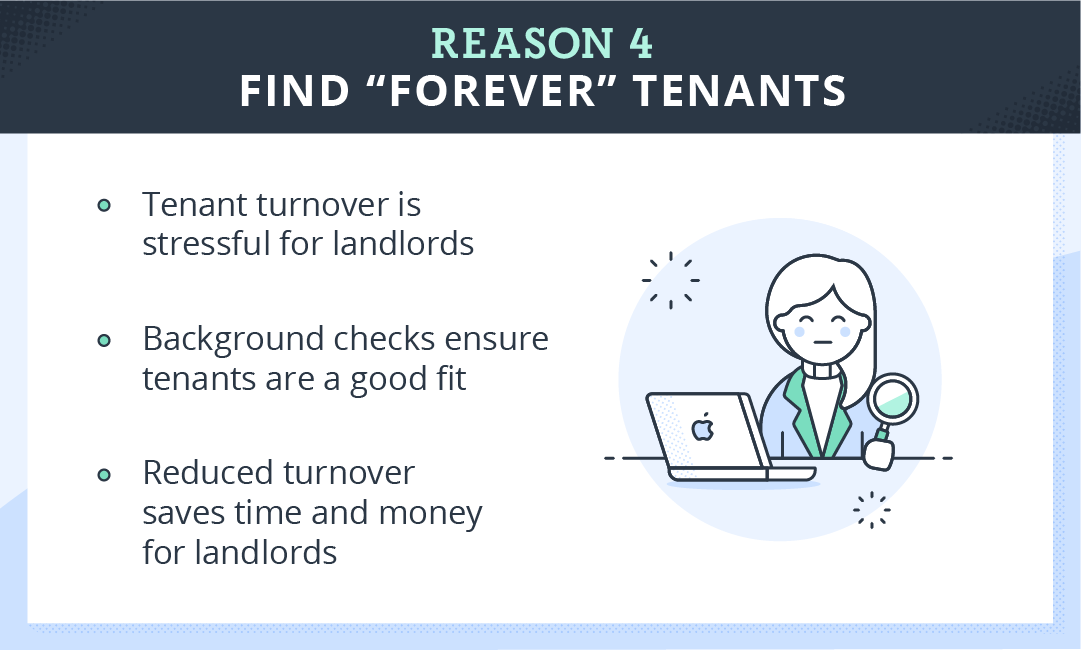
Every landlord wants to rent to high-quality tenants who pay rent on time every month, respect the property, and, ideally, decide to renew their leases. A background check is your best opportunity to find these renters during the application phase, thereby cutting your turnover, vacancy costs, and the revolving door of short-term renters.
How to Read a Tenant Background Check
Running a tenant background check for landlords is the first step. Once you have the reports, you’ll need to know what the numbers and facts all mean. Here are a few common questions that come up after the results arrive:
What credit score should a tenant have?
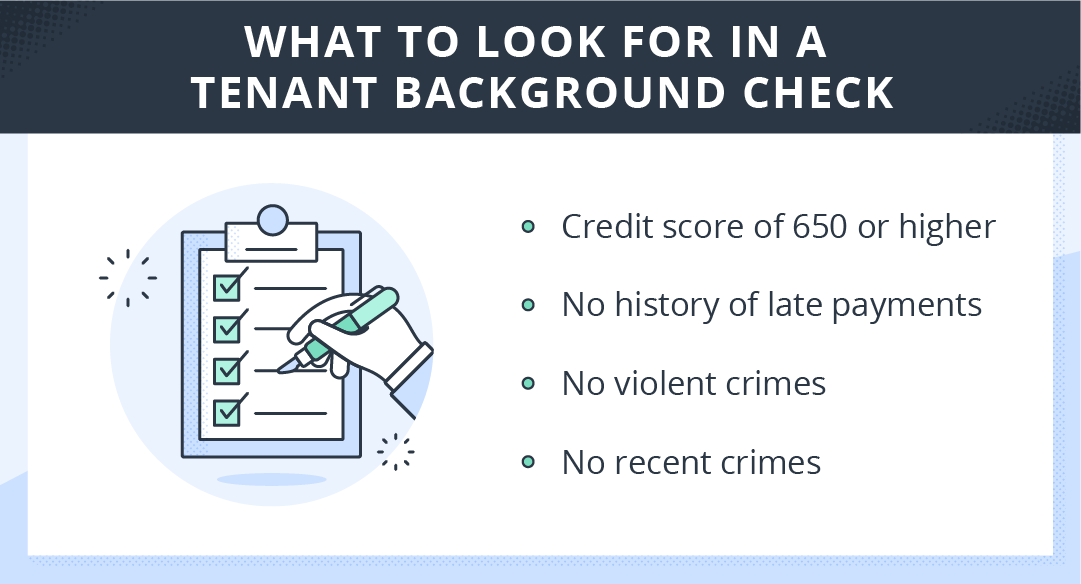
Your minimum credit score requirement depends on your local rental market and your risk tolerance. The mean U.S. credit score hovers around 715, though renters tend to have lower-than-average credit scores. With these factors in mind, most landlords typically want tenants to have a credit score of at least 600.
Look beyond the number: An applicant with a low score but a spotless payment history can be a safer bet than one with a higher score and a history of recent late or missed payments. Before making any decisions, evaluate the meaning behind the score.
How should landlords evaluate criminal history?
Never use “blanket bans” to deny every applicant with a criminal history. Instead, if a background check uncovers a criminal past, consider the type of offense, when it happened, and whether it shows a behavioral pattern. Per federal law, you must apply the same criteria to every applicant to ensure fair tenant selection. (And don’t forget to reference state laws, as some add further protections.)
How far back does a background check go?
Under the Fair Credit Reporting Act, most negative credit information won’t be on a report after 7 years. Many screening services follow that window, though some states have shorter limits on criminal and credit history. With that in mind, certain serious convictions may still appear on reports past the standard time frames, depending on the provider and jurisdiction.
How to Run a Tenant Background Check

No matter which service you use to run a tenant background check for landlords, doing so takes a few important steps. Property management software like TurboTenant can send digital applications that automatically gather everything you need to run background checks on all applicants.
Here’s what you need to do:
- Collect a completed rental application: Anyone who wants to live in your property must fill out a rental application and provide their personal and financial information. The application will ask for income, employment, rental history, and references, and give you enough information to run the tenant screening.
- Charge an application fee: Landlords typically charge a tenant-paid application fee of $35 to $75 per applicant, with TurboTenant’s own screening fee landing between $45 and $55.
- Request the applicant’s consent: During the application process, ask the tenant for their written consent to run a background check. Federal law prohibits landlords from running background checks without consent. Property management software handles this step automatically.
- Run the report through a tenant screening service: Tenant screening services do the heavy lifting for landlords by pulling credit, criminal, and eviction records from public databases and reporting sources. Once complete, the report provides landlords with a clearer view of the applicant’s rental risk.
How long does it all take? With most online screening services, landlords receive reports within minutes. However, checks that require crossing multiple jurisdictions or income verification can sometimes take a day or longer to complete.
Legal Requirements Landlords Need to Know

Though tenant screening laws may vary at the state, county, or even city level, two federal laws regulate tenant screenings nationwide. The Fair Credit Reporting Act (FCRA) governs the use of credit reports in housing decisions, while the Fair Housing Act (FHA) prohibits discrimination in all housing transactions.
Fair Credit Reporting Act: Under the FCRA, landlords must get the tenant’s written consent to perform a background or credit check. If a landlord denies housing based on information in a background check or credit report, they must notify the applicant of an adverse action, which must state:
- The reason for denial,
- The name and contact information of the company that generated the screening report, and
- The tenant’s right to dispute any inaccuracies.
Skipping this step can appear to be a bad-faith decision, even if a landlord’s reasoning was sound.
Fair Housing Act: The FHA prohibits landlords from discriminating against applicants based on the following protected characteristics:
- Race
- Color
- National origin
- Religion
- Sex, including sexual orientation and gender identity
- Familial status
- Disability
Under the FHA, landlords must also apply the same screening standards to every applicant. Importantly, every state has its own Fair Housing laws in addition to the federal law, and certain states further restrict criminal history review. As always, check your local laws.
Always keep documentation: Document your screening criteria and review local laws before accepting rental applications, and store every screening report and denial notice. An airtight paper trail can help protect you against accusations of discrimination or other legal violations.
Tenant Background Checks are Your First Line of Defense
Thorough background checks belong in every landlord’s rental workflow. Skipping it means gambling with your rental income and property, while a few minutes of due diligence at the start of a tenancy can remove much of the guesswork involved in finding a new renter.
This essential step verifies an applicant’s claims, uncovers red flags, and keeps you compliant with federal and state law. A compliance-minded screening process is one of the highest-return habits a DIY landlord can build.
To make tenant screening easier, use TurboTenant to run tenant-paid background and credit checks in minutes. Our software will handle the rental application, tenant consent, and report generation in a single streamlined process, so you don’t have to string together multiple tools to get the job done.
Sign up for a free TurboTenant account today to start filling your rentals with upstanding tenants.
Tenant Background Check FAQs
Who pays for a tenant background check?
Most landlords choose to pass the cost to the applicant as part of the application fee, so it rarely comes out of pocket. Some decide to cover the fee themselves to fill a vacancy fast or when local rules cap what they can charge tenants. In competitive markets, landlords often cover the fee themselves.
Can a landlord deny an applicant based on a criminal record alone?
Not automatically. HUD guidance discourages blanket bans on applicants with any criminal history, as such bans can trigger a Fair Housing Act claim. Landlords should weigh the type of offense, how long ago it occurred, and whether it relates to a legitimate safety or property concern.
Do all states allow eviction history in tenant screening?
No. Some states limit what eviction history can appear in tenant screening. California and Colorado seal many eviction filings before judgment, while Minnesota, Maryland, and Arizona require sealing or expungement in certain tenant-favorable outcomes. If an old or dismissed filing appears, treat it as a conversation starter (and not an automatic disqualifier).
What happens if a tenant disputes information on their background check?
The tenant will need to contact the screening company directly, not you, to challenge inaccurate information. That company will then investigate and correct any confirmed errors. You’ll then be able to reconsider the application once a corrected report comes back to you.
Should a landlord re-screen a tenant before a lease renewal?
Most landlords only screen at move-in, but a savvy landlord will run a fresh check after payment issues, unauthorized occupants, or complaints during the lease term. A clean rental history is usually reason enough to skip a repeat screening and move straight to lease renewal.