


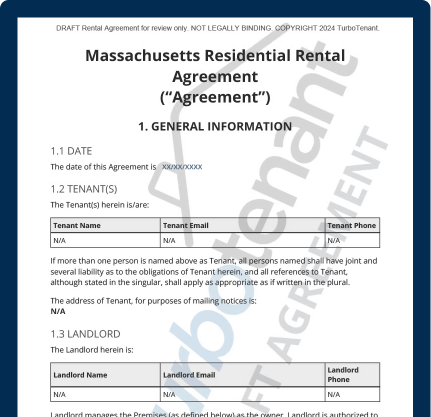
A Massachusetts residential lease agreement gives landlords and tenants a reliable rulebook before the rental arrangement begins. It outlines important details like rent, deposits, lease length, property rules, maintenance responsibilities, and state-specific laws that apply during the tenancy.
Because rental agreements are legal contracts, landlords should ensure their terms comply with current Massachusetts law before finalizing any agreement. Ready to draft your next contract? Click the link above to build your downloadable Massachusetts residential lease agreement in 15 minutes or less.

Massachusetts Residential Lease Agreement
Current PageCreate a compliant Massachusetts lease agreement in 15 minutes with TurboTenant's rental contract builder.
Massachusetts Month-to-Month Lease Agreement
Learn MoreBuild your Massachusetts month-to-month lease agreement in 15 minutes.
Room Rental Agreement Massachusetts
Learn MoreUse a TurboTenant Massachusetts room rental agreement to legitimize your house hacking endeavors.
Required Landlord Disclosures (7)
Disclosures help landlords give tenants legally required information about the rental property, lease terms, and certain tenant rights before or during the tenancy. Massachusetts landlords may need to provide the following disclosures, depending on the property, lease terms, and fees collected:
- Lead-based paint: For homes built before 1978, landlords must give prospective tenants the Massachusetts Tenant Lead Law Notification and Tenant Certification form before lease signing, along with any existing Letter of Full Compliance, Letter of Interim Control, lead inspection report, or risk assessment report. Landlords must also disclose known lead-based paint or lead-based paint hazards and provide the required federal lead pamphlet (105 CMR 460.725, 42 U.S.C. § 4852d).
- Move-in checklist: If a Massachusetts landlord collects a security deposit, the landlord must give the tenant a signed, written statement of condition when the landlord receives the deposit or within 10 days after the tenancy begins, whichever occurs later. The statement must list existing damage and include the required 12-point bold notice explaining that the tenant has 15 days to return corrections (Mass. Gen. Laws ch. 186, § 15B(2)(c)).
- Notice of occupants’ legal rights and responsibilities: Massachusetts landlords must give each occupant, or properly post, the Notice of Occupants’ Legal Rights and Responsibilities issued by the Department of Public Health. This notice belongs in a lease agreement article because landlords commonly provide required notices with the lease packet or at move-in (105 CMR 410.400).
- Executed lease copy: Massachusetts landlords must provide tenants with an executed copy of the rental agreement within 30 days of the tenant signing it. Any lease clause that tries to waive this requirement has no legal effect (Mass. Gen. Laws ch. 186, § 15D).
- Fire insurance: Landlords must provide information on the unit’s fire insurance policy within 15 days of receiving a tenant’s written request. The disclosure must include the insurance company’s name, the coverage amount, and the person who would receive payments (Mass. Gen. Laws ch. 186, § 21).
- Shared water and sewer charges: Massachusetts landlords may charge tenants separately for submetered water (and certain related sewer charges) only if they satisfy the state’s submetering requirements. This process includes proper submeter installation, required water-conservation devices, certification to the local board of health, and a written rental agreement explaining the tenant’s responsibility for water charges (Mass. Gen. Laws ch. 186, § 22F).
- Security deposit: If landlords collect a security deposit, they must provide a receipt within 30 days stating the deposit amount, the name of the person receiving it, the date it was collected, and a description of the unit. The receipt must also disclose the institution holding the funds and the account number (Mass. Gen. Laws ch. 186, § 15B(2)(b)).
- Landlord name and address: Nonresident landlords are required to post their name, address, and phone number in a visible location, often near mailboxes, or in the interior of the building (105 CM, § 410.481).
- Fee transparency regulations: Massachusetts fee transparency rules require landlords and their agents to clearly disclose the total price and required fees when advertising or offering rental housing. Landlords should keep lease charges consistent with those disclosures and avoid adding undisclosed mandatory fees at signing (940 CMR 38.00).
Security Deposit Regulations
Maximum security deposit amount: In Massachusetts, landlords may collect a maximum security deposit of 1 month’s rent (Mass. Gen. Laws ch. 186, § 15B(1)(b)(iii)).
Permitted upfront charges: Massachusetts landlords may require only certain upfront payments: first month’s rent, last month’s rent, a security deposit up to 1 month’s rent, and the purchase and installation costs for a key and lock. Landlords should avoid lease language that requires other upfront move-in charges unless a separate law clearly permits them (Mass. Gen. Laws ch. 186, § 15B).
Receipt of deposit: When a landlord receives a security deposit, they must give the tenant an initial signed receipt showing the amount, date received, recipient, landlord if an agent receives it, and premises description. Within 30 days after receiving the deposit, the landlord must also give a receipt identifying the bank, account number, deposit amount, and account location (Mass. Gen. Laws ch. 186, § 15B(3)(a)).
Interest: Landlords must pay tenants interest if they hold a security deposit for 1 year or longer, at either 5% or the actual amount received from the bank, whichever is less (Mass. Gen. Laws ch. 186, § 15B(3)(b)).
Deduction tracking: Massachusetts landlords may withhold funds from a security deposit for unpaid rent, unpaid real estate tax increases, or repair costs that exceed normal wear and tear, provided they follow the required itemized-deduction process (Mass. Gen. Laws ch. 186, § 15B(4)).
Returning a tenant’s security deposit: Landlords must return security deposits within 30 days after the tenant moves out, unless they lawfully deduct allowable amounts and provide the required itemized statement (Mass. Gen. Laws ch. 186, § 15B(4)).
Landlord’s Access to Property
Advance notice: Massachusetts does not set a specific statewide notice period before landlord entry. However, landlords should generally give reasonable notice and enter only for legitimate reasons, like necessary inspections, repairs, or emergencies.
Immediate access: Massachusetts landlords may enter a rental property without advance notice during emergencies or urgent conditions that threaten the property or the tenant’s health and safety.
Landlord harassment: Tenants can sue landlords who repeatedly enter a tenant’s unit, interfere with the tenant’s quiet enjoyment of the property, or engage in other forms of landlord harassment. Landlord harassment may allow a tenant to sue for damages equal to 3 months’ rent or actual damages, whichever is greater (plus costs and reasonable attorney’s fees) (Mass. Gen. Laws ch. 186, § 14).
Rent Payment Laws
Grace period: Massachusetts law does not set a standard rent grace period. Landlords may begin the eviction process when a tenant is late on rent, but they cannot charge late fees, interest, or other penalties until rent is at least 30 days overdue (Mass. Gen. Laws ch. 186, § 15B(1)(c)).
Late rent fees: As of 2026, Massachusetts does not set a statewide cap on late fees. However, landlords should state any late fee in the lease and cannot charge it until 30 days after the rent due date (Mass. Gen. Laws ch. 186, § 15B(1)(c)).
Tenant’s right to withhold rent: If a Massachusetts landlord fails to make required repairs or does not meet their legal obligations, tenants may withhold rent in certain situations. Tenants may also raise poor conditions as a defense or counterclaim in an eviction case and recover the difference between the agreed rent and the property’s reduced value (Mass. Gen. Laws ch. 239, § 8A).
Breach of Rental Agreement
Missed rent payment: Typically, a landlord can deliver a 14-Day Notice to Pay or Quit after a tenant is late on rent. For standard written leases, landlords may terminate the contract with 14 days’ written notice unless the tenant cures the nonpayment as allowed by law (Mass. Gen. Laws ch. 186, § 11). For tenants at will, the same 14-day notice rule applies (Mass. Gen. Laws ch. 186, § 12).
Lease violation: Massachusetts does not set a universal notice period for every standard lease violation. Landlords should address violation notices in the rental agreement and follow any applicable terms, local rules, and court procedures before pursuing eviction.
Self-help evictions: Landlords should never attempt to evict a tenant through self-help measures by changing the locks, shutting off utilities, or removing the tenant’s belongings without a court order. These actions may violate the tenant’s right to quiet enjoyment and expose the landlord to legal penalties (Mass. Gen. Laws ch. 186, § 14).
Lease abandonment: Even if a landlord suspects a unit is abandoned, they cannot simply retake possession. Landlords must use the judicial summary process (eviction) to recover the unit (M.G.L. ch. 184, § 18). Landlords should not change locks, remove belongings, or shut off utilities. These are illegal self-help evictions and can expose the landlord to damages (Mass. Gen Laws ch. 186, § 14).
Ending a Lease
Month-to-month: Landlords or tenants must give at least 30 days’ notice, or notice equal to the interval between rent payments if longer, to end a month-to-month tenancy in Massachusetts (Mass. Gen. Laws ch. 186, § 12).
Fixed-term: Tenants in Massachusetts cannot end a standard fixed-term residential lease early unless they have a legally protected reason, such as:
- Landlord harassment,
- Uninhabitable living conditions,
- Active military duty service, or
- Domestic violence, rape, sexual assault, or stalking (Mass. Gen. Laws ch. 186, § 14, § 24).
(Different protections may apply depending on the situation.)
Property abandonment: If a tenant leaves personal property behind, the landlord should attempt to contact the tenant at their last known address. If they do not receive a response after 60 days, the landlord may be able to treat the property as abandoned, depending on the type of property and applicable unclaimed-property rules (Mass. Gen. Laws ch. 200A, § 7).
Renewing a Lease
Required renewals: Massachusetts state law does not require landlords to renew a tenant’s lease when the lease term expires. However, landlords should avoid nonrenewal decisions that violate fair housing laws, retaliation protections, or other applicable local rules.
Required notice: Massachusetts does not require a specific notice window if a landlord chooses not to renew a yearly lease at the end of the term. For month-to-month tenancies, landlords or tenants must give at least 30 days’ notice, or notice equal to the interval between rent payments if longer, to terminate the agreement (Mass. Gen. Laws ch. 186, § 12).
Massachusetts Residential Lease Agreement FAQs
Does a landlord have to provide a copy of the lease in Massachusetts?
Yes. In 2026, Massachusetts landlords must provide tenants with an executed copy of any written rental agreement within 30 days of the tenant signing it (940 CMR 3.17(3)).
What is the grace period for rent in Massachusetts?
Massachusetts does not have a standard rent grace period. However, landlords cannot charge interest or late fees until rent is 30 days late (Mass. Gen. Laws ch. 186, § 15B).
Can a landlord refuse to renew a lease in Massachusetts?
Yes. Massachusetts landlords can refuse to renew a residential lease when the lease term ends, as long as the decision does not violate fair housing laws, retaliation protections, or other local rental rules.
Does a Massachusetts lease need to be notarized?
No. Massachusetts leases do not need to be notarized to be enforceable. However, both parties should sign the lease, and landlords must provide tenants with a copy within 30 days of signing (940 CMR 3.17(3)).
Can you withhold rent for repairs in Massachusetts?
Yes. Massachusetts tenants may withhold rent in certain situations if serious repair issues or code violations affect the rental property and the landlord fails to address them. Tenants should give proper notice, keep records, and understand that rent withholding may come up as a defense or counterclaim if the landlord files an eviction case (Mass. Gen. Laws ch. 239, § 8A).
Disclaimer: TurboTenant does not provide legal advice. This material has been prepared for informational purposes only. All users are advised to check all applicable local, state, and federal laws and consult legal counsel should questions arise.