


Landlords and tenants entering an Oregon residential lease agreement should first understand a few important legal basics. Also known as a rental contract, this document outlines the terms, rights, and responsibilities that govern the landlord-tenant relationship. A well-written lease agreement can help prevent misunderstandings, establish clear expectations, and protect both parties throughout the tenancy.
Let’s start by breaking down the disclosures landlords must include with each standard Oregon lease agreement.

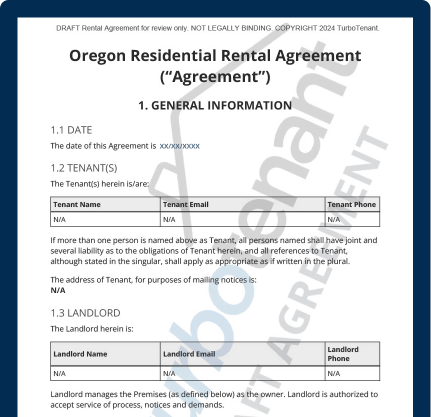
Oregon Residential Lease Agreement
Current PageCreate a compliant Oregon lease agreement in 15 minutes with TurboTenant's rental contract builder.
Oregon Month-to-Month Lease Agreement
Learn MoreBuild your Oregon month-to-month lease agreement in 15 minutes or less.
Room Rental Agreement Oregon
Learn MoreUse a TurboTenant Oregon room rental agreement template to lock in your house hacking operation.
Required Landlord Disclosures (11)
- Lead-based paint: As of 2026, federal law requires landlords to disclose known information about lead-based paint and lead-based paint hazards before the sale or lease of most housing built before 1978 (42 U.S.C. § 4852d).
- Landlord’s contact info: Oregon landlords must disclose in writing, at or before the start of the tenancy, the name and address of the person authorized to manage it and the owner or person authorized to act for the owner for service of process and notices (Or. Rev. Stat. § 90.305).
- Written lease copy: Oregon landlords must provide tenants with a copy of any written rental agreement, including any amendments or additions. Landlords must also retain a copy of the rental agreement and make it available for tenant inspection within a reasonable time after request (Or. Rev. Stat. § 90.220, § 90.305).
- Carbon monoxide alarm: Oregon landlords cannot enter into a new tenancy for certain dwellings with a carbon monoxide source unless the unit has properly functioning carbon monoxide alarms. Landlords must give new tenants written alarm testing instructions no later than the time the tenant first takes possession (Or. Rev. Stat. § 90.317).
- Common area utilities: Oregon landlords must disclose in writing, at or before the start of the tenancy, any utility or service the tenant pays directly to a provider and that also benefits the landlord or other tenants. If the agreement requires the tenant to pay a utility or service charge to the landlord, the landlord must explain how the provider assesses the charge and, when applicable, how the landlord allocates it among tenants (Or. Rev. Stat. § 90.315).
- Floodplain: If a unit sits in a 100-year floodplain, Oregon landlords must state in the rental agreement that the unit is within the floodplain (Or. Rev. Stat. § 90.228).
- Pending legal action: For premises containing no more than 4 dwelling units, Oregon landlords must disclose certain pending legal proceedings in writing before executing the agreement, including specified foreclosure, trustee sale, forfeiture, specific performance, and tax lien foreclosure matters (Or. Rev. Stat. § 90.310).
- Recycling: Certain landlords must provide tenants with information about local recycling programs, including instructions for sorting and disposing of recyclable materials properly (Or. Rev. Stat. § 90.318).
- Smoke alarm: Landlords must install working smoke alarms in rental units and notify tenants of their responsibility to test and maintain the devices (Or. Rev. Stat. § 479.270).
- Smoking: Oregon rental agreements must disclose whether smoking is prohibited on the premises, allowed throughout the premises, or allowed only in limited areas. If the policy allows smoking only in limited areas, the disclosure must identify those areas (Or. Rev. Stat. § 90.220).
- Renter’s liability insurance: If an Oregon lease requires renter’s liability insurance, the written rental agreement may require coverage up to the greater of $100,000 per occurrence or the customary amount for similar local rentals. Before the tenancy begins, landlords must also give applicants written notice of the insurance requirement, the required coverage amount, and a reasonable written summary of statutory exceptions (Or. Rev. Stat. § 90.222).
Security Deposit Regulations
Maximum security deposit amount: Oregon state law does not cap security deposit amounts. However, landlords in Portland should review the city’s ordinances, which limit the maximum deposit landlords may charge in certain situations (Portland City Code § 30.01.087).
Security deposit listed in the lease: Oregon written rental agreements must list any security deposit the tenant paid or the landlord requires. Landlords should clearly state the deposit amount in the lease rather than relying solely on a separate receipt (Or. Rev. Stat. § 90.300).
Receipt of deposit: Oregon landlords must provide tenants with a receipt for any collected security deposit (Or. Rev. Stat. § 90.300). State law does not require the receipt to disclose where the deposit is being held.
Deduction tracking: If landlords deduct money from a tenant’s security deposit, they must provide a written, itemized statement describing the deductions, along with receipts for repairs or related expenses (Or. Rev. Stat. § 90.300).
Returning a tenant’s security deposit: Landlords must return any remaining portion of the tenant’s security deposit within 31 days after the tenancy ends (Or. Rev. Stat. § 90.300).
Habitability defects: Landlords must return a tenant’s security deposit if habitability defects prevent the tenant from moving forward with the rental agreement (Or. Rev. Stat. § 90.300, § 90.320).
Landlord’s Access to Property
Advance notice: Unless an emergency requires immediate access, Oregon landlords must provide tenants with at least 24 hours’ notice before entering a rental property (Or. Rev. Stat. § 90.322).
Immediate access: Landlords may enter a rental unit without the tenant’s consent during emergencies that could cause serious property damage. After entering, landlords must provide notice within 24 hours explaining who entered the property, the reason for entry, and when the entry occurred (Or. Rev. Stat. § 90.322).
Landlord harassment: Under Oregon law, landlord harassment can include unlawful entry, unreasonable lawful entry, or repeated demands for access. Tenants may seek injunctive relief to stop the behavior, terminate the rental agreement, or recover actual damages resulting from the violation (Or. Rev. Stat. § 90.322).
Rent Payment Laws
Grace period: As of 2026, unless the lease agreement states otherwise, Oregon tenants receive a 4-day grace period after rent is due before landlords can charge late fees. In practice, landlords cannot impose late fees until the 5th day after rent becomes overdue (Or. Rev. Stat. § 90.260).
Late rent fees: Oregon landlords may charge late rent fees only when the written rental agreement states the type and amount of the late charge. The lease may use a reasonable one-time charge, a daily charge, or a charge equal to 5% of the periodic rent for every 5 days, or portion of that period, during which the rent remains delinquent, subject to Oregon’s timing and amount limits (Or. Rev. Stat. § 90.260).
Tenant’s right to withhold rent: Oregon tenants may withhold rent if the rental unit fails to meet required health or safety standards. Before doing so, tenants must provide written notice and allow the landlord a reasonable opportunity to complete the necessary repairs (Or. Rev. Stat. § 90.365).
Breach of Rental Agreement
Missed rent payment: If a tenant fails to pay rent, Oregon landlords may issue a notice requiring payment of the overdue amount or face eviction proceedings (Or. Rev. Stat. § 90.394).
Lease violation: When a tenant violates the terms of an Oregon residential lease agreement, the landlord may serve a notice giving the tenant time to cure the violation or vacate the property. If the problem goes unresolved, the landlord may proceed with eviction (Or. Rev. Stat. § 90.392).
Self-help evictions: Oregon law prohibits self-help evictions, including changing locks, shutting off utilities, or removing a tenant’s belongings without a court order (Or. Rev. Stat. § 90.375).
Lease abandonment: If a tenant abandons the rental unit before the lease term ends, Oregon landlords must make a reasonable effort to re-rent the property and mitigate financial damages (Or. Rev. Stat. § 90.410).
Prohibited lease clauses: Oregon lease agreements cannot waive tenant rights, authorize confession of judgment, limit landlord liability for certain misconduct or negligence, or require prohibited liquidated damages. Landlords should remove any unenforceable lease terms (Or. Rev. Stat. § 90.245).
Ending a Lease
Month-to-month: Oregon tenants must provide at least 30 days’ written notice to terminate a standard month-to-month lease. In most cases, landlords must provide 90 days’ written notice, although certain statutory exceptions may apply (Or. Rev. Stat. § 90.427).
Fixed-term: Oregon tenants may legally terminate a fixed-term lease early under certain protected circumstances, including domestic violence, sexual assault, or stalking (Or. Rev. Stat. § 90.453).
Property abandonment: If a tenant leaves personal belongings behind after vacating a rental unit, Oregon landlords must provide written notice explaining how the tenant can reclaim the property. Depending on the circumstances, landlords may dispose of the items after 15 or 30 days (Or. Rev. Stat. § 90.425).
Renewing a Lease
Required renewals: Oregon landlords are generally not required to renew an expiring standard residential lease agreement unless the lease itself grants the tenant a renewal right or another law applies. In most cases, renewal decisions remain at the landlord’s discretion.
Required notice: As of 2026, Oregon landlords must provide written notice if they do not plan to renew certain fixed-term leases. For residential lease agreements longer than 1 year, landlords generally must provide at least 90 days’ notice before the lease expires. However, landlords selling a residential rental dwelling may issue a 60-day notice instead of a 90-day notice if the tenant receives relocation assistance equal to one month’s periodic rent (Or. Rev. Stat. § 90.427).
Oregon Residential Lease Agreement FAQs
Does a landlord have to provide a copy of the lease in Oregon?
Yes, Oregon landlords must provide tenants with a copy of the signed rental agreement after both parties enter into the lease (Or. Rev. Stat. § 90.220).
What is the grace period for rent in Oregon?
Tenants have at least 4 days past the rent payment deadline before landlords can charge a late fee and issue a 144-hour notice to pay or vacate. Landlords must also ensure that their lease clearly outlines any late-fee policies and payment deadlines (Or. Rev. Stat. § 90.260, § 90.394).
Can a landlord refuse to renew a lease in Oregon?
Yes, Oregon landlords can refuse to renew a lease if they follow the state’s notice requirements and any applicable just-cause tenancy rules. The amount of required notice typically depends on how long the tenant has occupied the property and the reason for termination (Or. Rev. Stat. § 90.427).
Does an Oregon lease need to be notarized?
No, Oregon law does not require residential leases to be notarized. As long as both the landlord and tenant sign the lease agreement, it is generally considered legally valid and enforceable in court.
Can you withhold rent for repairs in Oregon?
Yes, Oregon tenants may be allowed to withhold rent or pursue other remedies if a landlord fails to maintain the property in a habitable condition. However, tenants must first provide proper written notice and follow the procedures outlined under Oregon law before withholding rent (Or. Rev. Stat. § 90.368).
Disclaimer: TurboTenant does not provide legal advice. This material has been prepared for informational purposes only. Users should review all applicable federal, state, and local laws and consult qualified legal counsel with any questions.