


An Iowa lease agreement defines the rights and responsibilities of landlords and tenants when renting property. It is a legally binding agreement that typically lasts for a year.
Though TurboTenant offers a lawyer-approved, customizable lease agreement builder to ensure accuracy, both landlords and tenants benefit from understanding their rights and obligations before signing the document. To get started, we’ll review the required disclosures landlords must include.

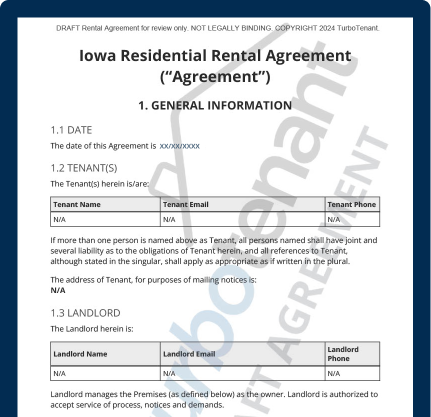
Iowa Residential Lease Agreement
Current PageCreate a compliant Iowa lease agreement in 15 minutes with TurboTenant's rental contract builder.
Iowa Month-to-Month Lease Agreement
Learn MoreGenerate an Iowa month-to-month lease agreement in only 15 minutes.
Room Rental Agreement Iowa
Learn MoreNeed to rent out an extra room? Make it official with an Iowa room rental agreement.
Required Landlord Disclosures (4)
State and federal law require the following disclosures:
- Lead-based paint: Federal law requires landlords to disclose known lead-based paint and hazards in most housing built before 1978, share any available records, include a Lead Warning Statement in the lease, and give tenants the EPA-approved pamphlet before the sale or lease (42 U.S.C. § 4852d).
- Landlord identification: Iowa law requires landlords to disclose the names and addresses of the person authorized to manage the property and the owner or person authorized to act on the owner’s behalf to receive notices and service of process (Iowa Code § 562A.13).
- Shared utilities: Unless tenants pay the utility company directly, Iowa landlords must disclose how shared utility charges and services are calculated and billed before signing the rental agreement (Iowa Code § 562A.13).
- “Superfund” sites: Iowa landlords must disclose whether the property is listed in the Comprehensive Environmental Response, Compensation, and Liability Information System (CERCLIS) (Iowa Code § 562A.13).
Landlords who fail to provide these disclosures before signing a standard Iowa residential lease agreement may face legal consequences or monetary penalties.
Security Deposit Regulations
Maximum security deposit amount: Iowa landlords may charge up to 2 months’ rent as a security deposit (Iowa Code § 562A.12).
Receipt of deposit: Iowa landlords are not required to provide security deposit receipts. They must, however, hold the deposit in an insured bank, savings and loan, or credit union account and may not commingle it with personal funds (Iowa Code § 562A.12).
Interest: Iowa landlords may hold security deposits in interest-bearing accounts. Any interest that accrues during the first 5 years of the tenancy belongs to the landlord rather than the tenant (Iowa Code § 562A.12).
Deduction tracking: Within 30 days after the tenancy ends and the landlord receives the tenant’s mailing address or delivery instructions, the landlord must return the deposit or provide a written statement giving the specific reasons for withholding any portion. A landlord who misses that deadline forfeits the right to withhold any part of the deposit (Iowa Code § 562A.12).
Returning a tenant’s security deposit: Iowa landlords must return the security deposit, minus any lawful deductions, within 30 days after the tenancy ends and the landlord receives the tenant’s mailing address or delivery instructions (Iowa Code § 562A.12).
Landlord’s Access to Property
Advance notice: Unless there is an emergency, Iowa landlords must give tenants at least 24 hours’ notice before entering the rental property and may enter only at reasonable times (Iowa Code § 562A.19).
Immediate access: Landlords may enter the property without notice in an emergency (Iowa Code § 562A.19).
Landlord harassment: Tenants have the right to quiet enjoyment of their rental property. If a landlord makes repeated demands for entry or other entries that harass the tenant, the tenant may obtain a court order to stop the conduct, recover damages, or terminate the lease (Iowa Code § 562A.35).
Rent Payment Laws
Grace period: Iowa does not mandate a grace period for late rent payments. Landlords may include one in the Iowa residential lease agreement, however (Iowa Code § 562A.9).
Late rent fees: Iowa caps late fees by rent amount. For rent of $700 or less per month, landlords may charge up to $12 per day, capped at $60 per month. For rent over $700, landlords may charge up to $20 per day, capped at $100 per month. Late fee terms must be stated in the lease (Iowa Code § 562A.9).
Tenant’s right to withhold rent: Iowa does not let a tenant simply stop paying rent. After proper written notice, though, a tenant may correct certain deficiencies and deduct the cost as a defense in a nonpayment action (Iowa Code § 562A.27). For a landlord’s failure to supply an essential service such as heat or water, the tenant may instead obtain substitute service and deduct the cost, recover damages, or get substitute housing with reduced rent (Iowa Code § 562A.23).
Breach of Rental Agreement
Missed rent payment: If a tenant does not pay rent when due, landlords may issue a 3-day Notice to Pay or Quit before terminating the rental agreement (Iowa Code § 562A.27).
Lease violation: For other material lease violations, the landlord may deliver a written notice describing the breach. The tenant has 7 days to correct the issue before the landlord may terminate. If substantially the same violation recurs within 6 months, the landlord may terminate on 7 days’ notice without another chance to cure (Iowa Code § 562A.27).
Self-help evictions: In Iowa, landlords cannot force tenants out by changing the locks, shutting off utilities, removing doors or windows, or using other self-help eviction tactics (Iowa Code § 562A.33).
Lease abandonment: If a tenant abandons the property before the lease ends, Iowa landlords must make reasonable efforts to re-rent the unit and reduce the damages owed by the tenant (Iowa Code § 562A.29).
Ending an Iowa Lease
Month-to-month: Either the landlord or tenant may terminate a month-to-month Iowa residential lease agreement with at least 30 days’ written notice (Iowa Code § 562A.34).
Fixed-term: Tenants may break a fixed-term lease early if the landlord materially fails to maintain the unit or supply an essential service such as water or heat, after giving the landlord the required written notice and a chance to fix the problem (Iowa Code § 562A.21, § 562A.23). Active-duty servicemembers who receive qualifying military orders may also terminate under the federal Servicemembers Civil Relief Act (50 U.S.C. § 3955).
Property abandonment: Iowa does not have a specific statute that lays out a step-by-step process for disposing of a tenant’s personal property left behind after move-out, and Iowa courts have generally addressed the issue through case law. Landlords should document the property, give the tenant notice, check any local requirements, and consult legal counsel before disposing of anything of value.
Renewing a Lease
Required renewals: Iowa landlords are not required to renew a standard lease agreement unless the lease itself guarantees a renewal option.
Required notice: Landlords must provide 30 days’ written notice if they do not plan to renew a month-to-month lease. Fixed-term leases generally end on the expiration date listed in the agreement without requiring additional notice of nonrenewal (Iowa Code § 562A.34).
Iowa Residential Lease Agreement FAQs
Does a landlord have to provide a copy of the lease in Iowa?
No, Iowa law does not require landlords to provide tenants with a copy of the lease agreement, though both parties should keep a signed copy for their records in case questions or disputes arise later.
What is the grace period for rent in Iowa?
Iowa law does not require a grace period for rent payments. In many cases, landlords include a short grace period in the lease agreement before charging late fees.
Can a landlord refuse to renew a lease in Iowa?
Yes, Iowa landlords can refuse to renew a lease as long as they follow the notice requirements outlined under Iowa law (Iowa Code § 562A.34).
Does an Iowa lease need to be notarized?
No, Iowa lease agreements do not need to be notarized to be legally binding. Once both parties sign the lease, it is generally enforceable under state law.
Can you withhold rent for repairs in Iowa?
Yes, Iowa tenants may be able to withhold rent if a landlord fails to make required repairs after receiving written notice (Iowa Code § 562A.27). However, tenants should always follow the proper legal process before withholding payment.
Disclaimer: TurboTenant does not provide legal advice. This material has been prepared for informational purposes only. All users are advised to check all applicable local, state, and federal laws and consult legal counsel should questions arise.